In March 2025, we came together as a group of like-minded friends to put together several tips on surviving the dreaded overnight call for our incoming house officers.1 Other members in our local medical community have also contributed useful articles sharing insights on pre-rounding, referral making and discharge summary writing.2,3 In this piece, we aim to elucidate the seven essential components of a good ward round entry, which can be remembered with the mnemonic "POSh-SOAP" – patient demographics/pertinent social background, old records (past medical or surgical history), summary of current admission/history of presenting complaint, subjective, objective, assessment (issues and progress), and plans. We hope that junior trainees and student interns doing their clinical rotations in the hospitals will find this article useful. The importance of efficiently and comprehensively written rounding note documentation cannot be overstated – it helps to ensure that the patient's past and current medical issues are succinctly and accurately captured, and helps readers (be it other medical professionals, nurses, allied health professionals or the on-call team) to be able to decipher the salient aspects of the patient's case to guide their actions and decision-making.
Patient demographics/pertinent social background
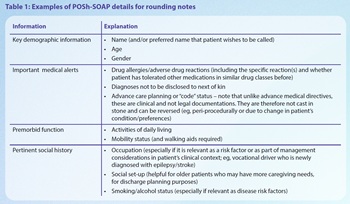
At the beginning of the ward round entry, besides documenting the consultant or team in charge, you should provide pertinent patient details and social background as relevant to the current clinical diagnoses, management and/or discharge planning. Table 1 provides examples of types of details that should be recorded.
Old records (past medical/surgical history)
It is important to succinctly and accurately summarise the patient's past medical/surgical history, ensuring it is kept up to date, and ideally categorised appropriately for ease of reading. The past medical history is often copied over from the last discharge summary on the National Electronic Health Record, which may contain inaccuracies, outdated and/or irrelevant details. Therefore, due diligence in cross-referencing, summarising and updating the past medical history with information from the patient or family, other documentation (eg, clinic, procedure, progress or subspecialty consult notes), and/or investigation reports/findings is necessary. For example, if a patient has diabetes mellitus, it would be helpful to specify whether it is type 1 or 2 physiology, with documentation of the latest HbA1c. On the other hand, in a patient with a history of coronary artery disease with heart failure, it would be helpful to include a summary of previous procedures (eg, diagnostic coronary angiogram or percutaneous coronary interventions) and the latest transthoracic echocardiogram for left ventricular ejection fraction. In addition, grouping of similar conditions based on systems/specialty (eg, cardiovascular, pulmonary, gastrointestinal, renal, eye, surgical, orthopaedic), and even separating out the most important medical history pertinent to the current admission (eg, renal/dialysis history for nephrology patients, or cancer diagnoses and treatment history for oncology patients) can improve the readability of this section. If there was a recent admission, it may be helpful to summarise briefly the main events and interventions administered.
Summary of current admission (history of presenting complaint)
A simple summary of the reason for current admission and/or pertinent inpatient events would help to jog the memory of the junior or the reader on the patient's case and initial presenting complaints. This could be, for example, "presented on XX date for fever, productive cough, night sweats and constitutional symptoms, subsequently diagnosed with active pulmonary tuberculosis"; "developed hospital-acquired pneumonia and went to ICU from XX to XX date for type 1 respiratory failure requiring high-flow nasal cannula, but subsequently improved and stepped down to general ward on XX date". It also helps with ward round presentations, especially when the junior physician or trainee is taking care of numerous patients and may not readily remember all the cases.
Subjective
This section should document any overnight events (including "called to see patients", nursing concerns, or investigations that were newly reported), the patient's current active complaints, and targeted history-taking/questions looking for associated symptoms/complications and/or significant negatives in the given clinical context. It is also important to write down salient aspects of clinical communications (eg, explanation of provisional diagnoses and investigation/management plans to the patient) during ward rounds/pre-rounds at the bottom of this section.
Objective
Documentation of physical examination findings should include vital signs and other key parameters (eg, blood sugar trend, intake-output charting), as well as targeted, relevant physical examination findings that were actually performed on that day. It is crucial that the prevalent practice of "copy-pasting" is curbed, which has potentially serious implications in patient safety and medico-legal risks.4 For example, for a patient who came in for a fall and had normal neurology on admission, if the neurological findings were copied in daily clinical entries when they were not actually re-performed, it would be both dishonest and dangerous – as the patient could have developed a new intracranial event (eg, stroke) inpatient.
Assessment (issues and progress)
Crafting of a good "issues list" is an important skill that takes practice. The ability to synthesise the patient's clinical presentation and investigation findings into well-crafted problem lists demonstrates good clinical reasoning skills and is a mark of a mature clinician. It is important to provide provisional diagnoses/differential considerations for the patient's clinical problem – for instance, it is not appropriate to write "chest pain or breathlessness for investigation" as the issue throughout admission, nor to state a laundry list of abnormal investigations without alluding to possible underlying causes. We suggest that issues should be sequenced from active diagnoses to passive/resolved events. Clinical problems which are part of manifestations of multi-systemic conditions or complications of disease/ treatment should be listed as sub-issues to the primary diagnosis. Underneath each new diagnosis, it would be good to incorporate a short description of the patient's relevant clinical presentations, summarised with semantic qualifiers (eg, acute inflammatory oligoarthritis of the left ankle and both metatarsophalangeal joints, on a background of known chronic tophaceous gout non-compliant to low-purine diet and urate-lowering therapy). For more complicated diagnoses, it is a good habit to incorporate differential diagnoses with reasons for and against each diagnosis in order to make clinical reasoning/thought processes explicit. Following this, incorporate pertinent investigation findings and treatment/procedures performed. Finally, document the current clinical progress and treatment response. While the above represents the authors' suggestions in the framing of issues lists, we understand that different people have their own writing and stylistic preferences – which is perfectly fine, so long as the section conveys the clinical thought processes about the patient's problems and summarises the investigation/treatment progress.
Plans
Fresh out of medical school, it is common to see junior physicians structuring clinical plans as follows: nursing interventions (eg, vitals, diet, intake-output charting, blood sugar monitoring, fall and other precautions, and other forms of charting), allied health involvement, investigations, management, extent of care and discharge/follow-up plans. This is a reasonable structure, but it is important to remove completed tasks from the plans (eg, completion of a course of antibiotics) and avoid unnecessary copy-pasting of the exact same nursing, vitals/chart monitoring or dietary plans that lead to information clutter and risk of missing out important information. It may be helpful to use colour coding or bold the important/urgent changes that need to be done on the same day. It also allows your colleagues to help with your changes on busy days.
Conclusion
In summary, these are the seven key components of a rounding note, which can be summarised by the "POSh-SOAP" mnemonic. Proper clinical documentation and ability to write good "clinical issues/problem lists" are required skillsets of every physician, especially in the current information age.