James Ang, 24 years old, is a para-athlete, national record holder and law graduate whose journey has been defined by constant adaptation and forward momentum. Diagnosed with Stargardt macular dystrophy, he represents Team Singapore in the T1B sports classification and holds the national records in the 200m and 400m sprints. As he trains towards the 2028 Los Angeles Paralympic Games, James also draws on his legal education from the Singapore Management University School of Law, pursuing ambitions beyond the track with the same discipline that defines his sport.
James' early years in school were shaped by learning how to access print independently. Through iC2 PrepHouse, a charity that supports children with low vision, he was introduced to electronic magnifying units from primary school through junior college, enabling him to read, write and keep pace in mainstream classrooms. As academic demands shifted in university and later into professional life, iC2 supported his transition to assistive technologies that became integral to how he studies, works and engages with an increasingly digital environment. More recently, as his visual challenges evolved, iC2 provided orientation and mobility training, supporting his adjustment to using a white cane as part of daily living.
Alongside these tools, iC2's teachers walked closely with James through moments of uncertainty, patiently guiding him through unfamiliar systems and working through challenges as they arose. Equally formative were the relationships built through iC2. Meeting Prof Wong Meng Ee offered James a living example of navigating life with confidence and purpose, and encountering fellow para-athlete Sophie Soon taught him that sporting excellence was not only possible but attainable. These encounters, paired with consistent guidance over the years, shaped how James learned to approach both obstacles and ambition – steady in resolve, confident in direction and unafraid to pursue goals once thought beyond reach.
Visual impairment in Singapore and the need for support services
The setup of iC2 PrepHouse was first announced in the March 2015 issue of SMA News, 2015. Dr Audrey Looi, then an oculoplastic surgeon at the Singapore National Eye Centre and caregiver for her son, James, explained the motivation and need for specialised care management by trained vision teachers. The type of care needs and early intervention programmes for such children were subsequently described in the January 2019 issue of SMA News by the principal vision teacher at iC2 PrepHouse, Ms Lee Lay Hong. James' personal account highlights two pivotal capabilities of iC2 PrepHouse: individualised lifelong learning, and a need for compliant data infrastructure to capture longitudinal information of the individual.
In this article, we expand the use of a predictive data-driven analysis that allows for the evaluation of our unique early intervention programmes. This endeavour is in line with the recent SG 60 Towards Sustainability Fund announcement by the National Council of Social Service. This seed funding encourages social service agencies (SSAs) to kickstart their capabilities in measuring, monitoring and reporting the effectiveness of their programmes. Ultimately, this translates to establishing trust and confidence in stakeholders by producing quantifiable outcomes and ultimately facilitating objective funding.
Conditions leading to low vision in a rapidly ageing population include macular degeneration and glaucoma. As these conditions worsen, support programmes at various SSAs provide the individual with skills to manage and adapt. The use of assistive technology comprising screen readers, magnifiers, mobility white canes or Braille devices facilitates the habilitation process. However, in children with low vision, it becomes critical to implement programmes geared towards both education and habilitation.
Data-driven approach for programme evaluation
Launched in 2022, Singapore's Enabling Masterplan 2030 lists important milestones towards building an inclusive society, among which include bolstering inclusive employment opportunities and fostering an inclusive community.
Monitoring and follow-up of clinically verified persons with disabilities is limited due to the absence of medical- social integration, yet we know that lifelong learning is an important component contributing to the quality of life of the child. For many disabilities, employment outcomes may not be sustainable, so it is critical for SSAs to adopt objective methods that are disability-specific and extend beyond attitudes-based surveys to quantify their programmes. This often involves a community of clinical, allied healthcare professionals, specially trained teachers and adequate caregiver support.
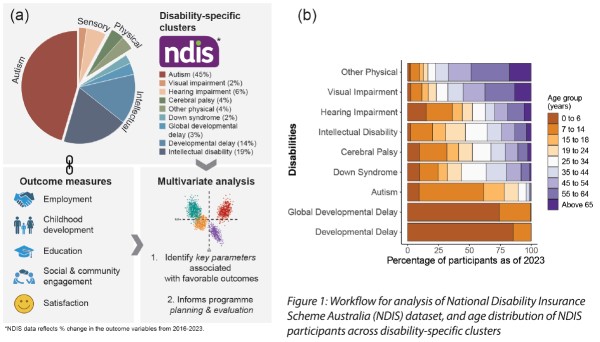
We leveraged our colleagues' expertise to explore well-curated global disability datasets. The National Disability Insurance Scheme (NDIS) Australia dashboards facilitate fund utility monitoring across 15 types of disabilities. It includes over 646,000 participants to-date.1 Such a pre-emptive approach alerts us of programmatic criteria correlated with beneficial outcomes to be included in iC2 PrepHouse's evaluation framework. The types of disabilities and outcome measures in NDIS are illustrated in Figure 1, with further analysis showing that individuals with visual impairment stretch across all age bands.
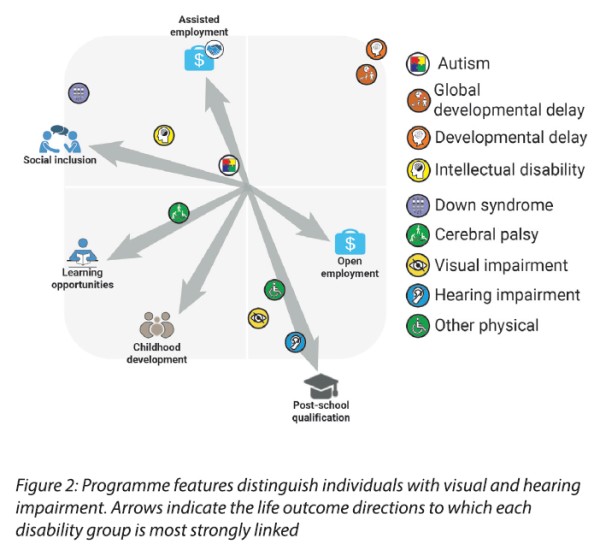
Next, we used multivariate analysis to identify key parameters associated with beneficial outcomes. Figure 2 shows the widely adopted Principal Component Analysis map method to accommodate for multiple parameters and their interrelatedness. It depicts how participants with different disabilities are associated with important life outcomes such as childhood development, learning opportunities, social inclusion, post- school qualifications, and open/ assisted employment. By mapping these relationships, the figure highlights which areas of support are most significant for each disability group and how they influence long- term opportunities and/or outcomes. Individuals with visual impairment can engage in open/sustainable employment if they are provided with learning opportunities, childhood development and post-school education. Currently, local government- driven efforts are being stepped up to close the gap, also known as the "post-18 cliff", when persons with disabilities leave school but are not yet well equipped to seek employment or more independent living.
Early intervention is critical for lifelong learning
iC2 PrepHouse has achieved significant recognition and milestones, including winning the APAC Insider Singapore Business Award for Best Visually Impaired Children's Educational Programmes and the Charity Governance Award in 2022. To date, iC2 PrepHouse has helped 301 clients. To add more granularity to these encouraging numbers, the charity is committed to data acquisition and evaluation that specifically reflect the quality of its intervention programmes. For example, our vision teachers have adopted the Goal Attainment Scaling method, which has since been extended to a variety of conditions including visual impairment,2 dementia and other comorbidities. It is a person-centred and collaborative approach incorporating functional data and clinical diagnosis, thereby facilitating assessment of the effectiveness of an intervention on personally relevant goals. Life goals are broken down into smaller, stepwise goals as no child or disability are the same. This longitudinal profiling thus reflects the true progress of the individual. We are also establishing a database and visualisation portal that will empower sharing and communication as the child progresses through life.
Conclusion
In Singapore, disability care and management are outside the purview of healthcare institutions. Often, this means that as the person with disability progresses through life, information that might be beneficial such as early intervention programme quality is lost and/or cannot be shared due to non-compliant data governance and infrastructure. This is especially damaging for such children. We hope that our thoughts and experiential journey at iC2 PrepHouse in this update will motivate more professionals in the social service sector, healthcare institutions and researchers to collaborate and achieve greater clarity that will guide programme planning and more directed and sustainable funding.