My lived experience with health communications and behavioural change
Ten years ago, I started a journey to help people who smoked quit smoking. As a public health specialist, this was right down my alley.
The military has had an interesting tango with cigarettes – from depictions of smoking in World War II trenches as a form of relief to its association with masculinity and coming of age, and in Singapore – smoking in "yellow boxes" as a way to bond.
One of the things that I learnt early in the journey was this: while knowledge, attitudes and beliefs are important in helping us understand what is needed, it is not enough. Along the way, we discovered three things that worked – having someone who cares about you and your habit, being able to talk to someone about your habit, and having a clear mission and purpose for why one wants to quit the habit.
We knew what works. We did it, and it worked. But looking back, I would say that we had deftly stumbled upon the secrets of success without a full understanding of the science behind it. As it turns out, the discovery and the science were only just catching up.
The age of AI and the changing doctor-patient relationship
Today, we are facing an epidemic of information overload. The Internet has changed how we receive information. The great thinkers of our time have likened this to an era where we are "data rich, information poor". In short, information does not translate into insights, decisions and impact. The era of artificial intelligence (AI) has commenced, with more discoveries and breakthroughs expected in the future.
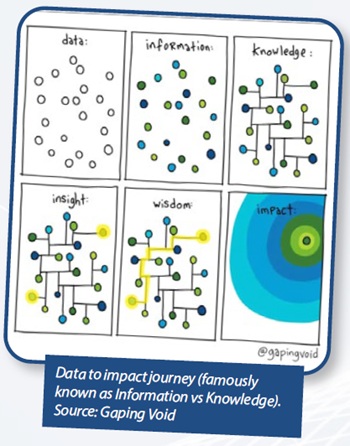
Looking at the spectrum of "Data – Information – Knowledge – Insights – Wisdom", one can forecast that the use of AI will flood us with Data, Information and perhaps even Knowledge, but may whittle away at people's ability to form Insights and gain Wisdom.
Every doctor-colleague I meet today will have stories of patients who have been informed (or misinformed) by the Internet, often prefaced with "A little knowledge is a dangerous thing" before segueing into their horror stories. I believe that a patient with no knowledge of his/her condition is also not ideal. The answer lies somewhere in-between – a patient who knows enough about his/her health condition and is humble enough to take the doctor's insights and wisdom into his/her decision-making framework.
Keeping up with the times – from knowledge-based care to relationship-based care
As doctors, we have to play our part too. The science of health communication is changing. What we learnt in medical school about health communication is important but is now incomplete as new science emerges. Let me elaborate.
Health communication has traditionally been one-way – we tell and we inform. Anyone reading this article will intuitively know that this approach works in some but not all situations. It is important to remember the following.
1. Not all advice lands – context matters.
Often, advice fails because we may not be fully aware of the context. For example, is telling a diabetic patient to not eat white rice effective? It is medically correct (and what we have been taught). The patient may nod in reverence when he is in your consultation room, but as soon as he leaves your clinic and goes to the hawker centre, what healthy choices does he have? And what healthy choices can he afford?
2. People do not care how much you know, until they know how much you care.
Healthier SG is trying to achieve this by encouraging patients to see a regular doctor. Relationships and trust take time to build. Patients take advice better when they feel that the doctor understands and hears them, and is able to give them advice that considers their personal values and situation. At the risk of sounding like doctors are going the way of banking, we must learn to be relationship managers. We have to know how to practise relationship-based care.
3. Be realistic about what we can achieve so we can keep going.
I have learnt that even the best smoking cessation programmes in the world have a success rate of only one in eight. I have also learnt that many people who successfully quit smoking did not succeed on their first attempt; relapse is common and we just have to try again. Thus, health communication, like evangelism, is often more about the process than the outcome. You need to find the reason to keep going, learn from the process and not be too hard on yourself when your advice is not taken.
The health communications toolbox: what, when and how to use it
The science of health communication now includes dialogue and participation. In Singapore, terms like shared decision¬making, co-design of health services, community engagement, and patient and public involvement are not unfamiliar. But these approaches take more time and resources.
In such situations, I like the use of complexity science. One way to frame and approach them is along the spectrum of "Simple – Complicated – Complex", to decide when to use the more traditional "tell" form of health communication and when to adopt a personalised and adaptive approach.
Simple – A patient with an upper respiratory tract infection requires symptomatic relief and possibly antibiotics. In this case, we can be straightforward and simply inform the patient of the diagnosis and treatment plan. Being too long-winded may actually upset the patient, who may question why a simple consultation is being prolonged.
Complicated – A patient with a chronic condition, such as diabetes or eczema, requires changes in lifestyle and habits. Here, it is important to understand the patient as a person – his/ her values, lifestyle and circumstances – in order to provide insights and advice that are personalised and suited to his/her context.
Complex – A patient with complicated chronic conditions may require end-stage care and end-of-life discussions. Doctors working in this space intuitively know they must spend more time understanding the patient and his/her family situation, as well as his/her values, priorities, preferences and wishes. The patient's narrative – his/her understanding of the illness, concerns and expectations of treatment and the future – is deeply personal. A strong rapport with the doctor enables the patient to be more receptive to the doctor's insights and advice. These conversations help to acknowledge, align and possibly converge the patient's and doctor's narratives, leading to a process of co-constructing meaning that respects patient values and choices. This process requires time and resources, so both parties must acknowledge this and manage their expectations.
"One-to-one" and "one-to-many" health communication
In the clinical setting, health communication usually takes place in a "one-to-one" context. Increasingly, doctors are asked to take on roles that require them to communicate with groups, such as giving public health talks, driving community care initiatives, or designing and fronting public communication during a pandemic response. The "Simple – Complicated – Complex" framework can also be applied to public health communication. Understanding this framework helps explain why accurate health information may be rejected, while misinformation spreads more easily when it aligns with people's existing narratives.
Consider the "one-to-many" type of public health communications around topics such as smoking, vaping, asthma, reproductive health, birth control, diabetes, hypertension, dementia, depression, anxiety, autism, frailty and end-of-life care. These are not issues where we can simply "tell" people what to think or how to think. Depending on the setting, these topics may require space for dialogue, conversation and opportunities to converge on a shared narrative.
In ageing societies, public health advice regarding frailty and dementia may conflict with older adults' worldview and understanding of independence and dignity. In countries with low birth rates like Singapore, subsidies for assisted conception procedures are helpful, but more can be done to shape the narrative around women having babies later in life. Overly simplistic and uni-dimensional public health communications that fail to acknowledge the personal nature of such health decisions may not land well and may even backfire.
In 2012, the Health Promotion Board worked with Ogilvy Asia to create a powerful anti-smoking campaign that encompassed many of the principles outlined above for a deeply personal habit and choice. The "I Quit because..." campaign featured personal stories of individuals choosing to quit smoking as a personal choice, for reasons such as "I want to be a role model for my kids", "I wish to achieve my aspiration" or "My wife refused to kiss me".
In short, when health information and messaging clash with people's worldview, they are more likely to be rejected.
What this means for health literacy, the patient and the populace
Medical science is evolving so rapidly that it is understandable that doctors may feel overwhelmed. When doctors peg themselves primarily as knowledge workers, the expectation to keep up with the latest knowledge stacks up, and at some point, they may fall behind. Knowledge and information remain important, but with AI, medical knowledge is increasingly democratised.
A more reasonable and sustainable approach would be to balance the medical knowledge work and getting to know the patient that we are caring for better and in a more personal way. This way, our knowledge, insights and wisdom about our patients' health can be communicated in ways that are more acceptable and usable by our patients.
I am optimistic that overall health literacy for Singapore and our patients will improve over time. Information and knowledge are now more accessible, and there is a growing national narrative that "health is important as we get older together". However, to improve health communication – between doctors and patients, and between doctors and the populace – we will need to work at building shared narratives on health and finding shared meaning in living healthier lives together.
Disclaimer: No generative AI was used in any part of this creative and writing process.
Further reading
- Tan C, Lin L, Lim M, Ong SK, Wong ML, Lee JK. Tobacco use patterns and attitudes in Singapore young male adults serving military national service: a qualitative study. BMJ Open 2020; 10(9):e039367.
- Tan C, Pong J, Tan CH. Observing World No Tobacco Day – The SAF Experience. SMA News 2022; 54(3):20.
- Lim MK, Soh CS, Tan YS, Leong CK. Smoking in the Singapore Armed Forces. Singapore Med J 1997; 38(2):50-3.
- Campaign Asia. Ogilvy Singapore celebrates quitters in anti-smoking drive. Available at: https://bit.ly/4mwTjEC.
- Okuhara T, Okada H, Yokota R and Kagawa Y. Redefining health communication through narrative intersection: opening closed narratives and co-creating meaning. Front Commun (Lausanne) 2025; 10:1672808.
