Every year when September comes along, it marks that time of the year when we get together with colleagues from National Medical Associations (NMAs) from across the Asia-Pacific region for serious discussions and sharing on what we are doing for our constituents, our patients and our nations.
A delayed meeting
This year was no different and we were to be hosted by the Nepal Medical Association. However, the meeting in mid-September was derailed by the 2025 Generation Z (Gen Z) protests. We were shocked by videos that showed the five-star Hilton hotel in Kathmandu gutted by fire. Fortunately, that hotel was not our venue for the conference. The meeting was nevertheless postponed and we convened on 12 December 2025 at a resort hotel in the suburbs of Kathmandu. We were warmly welcomed by Dr Anil Bikram Karki, the current president of the Confederation of Medical Associations in Asia and Oceania (CMAAO) who was installed in a Zoom meeting conducted earlier in the year.
Twelve NMAs attended the meeting, with seven joining in person and the rest online in a hybrid meeting, where the theme was "Disaster Preparedness, Response and Management". The guest of honour was the Nepal Minister for Health and Population, Dr Sudha Sharma Gautam, who was a past president of the Nepal Medical Association. She was very much at home when she graced our meeting, and I asked her about the situation on the stability of the country. She was appointed to the role by the interim leader Sushila Karki, who was a former Chief Justice, after the Gen Z protests. The Gen Z protests were triggered by a shutdown of all social media platforms on 4 September 2025, a response to a social media trend focusing on nepotism among the children of the ruling elite. The situation had calmed down by the time we met in December, and the nation's focus was on rebuilding and the elections due in March 2026.
We always have the Taro Takemi oration lecture at our CMAAO meetings and this year was no exception. Dr Taro Takemi was the president of the Japan Medical Association for 25 years from 1957. He was instrumental in establishing CMAAO in 1956 and he also served several terms as the president of CMAAO. At the 1977 CMAAO general assembly, Dr Taro Takemi highlighted issues such as ageing of the population, seriousness of pollution and its impact on the environment, and was also concerned about the impact of medical progress and soaring medical costs due to ageing that will put a strain on national finances. Indeed, he was a visionary and prescient about the issues that are facing many of our nations today. Hence in 1991, the Taro Takemi Memorial Oration lecture series was established with donations from the Japan Medical Association and the Takemi family.
The speaker of the oration lecture this year is Dr Kenza Bennani who works for the World Health Organization in Nepal. She is a Moroccan epidemiologist and her talk on disaster preparedness was most illuminating.
National response to disasters
Those of us in Singapore have often taken for granted the safety and security we enjoy and the lack of natural calamities. However, we have in recent years had disasters in our fellow CMAAO member nations including typhoons in the Philippines and Myanmar, earthquakes in Nepal, floods in Pakistan, and tsunamis and earthquakes in Japan and Indonesia. CMAAO had in recent years donated funds for disasters to the NMA of the affected nations.
During the meeting, member NMAs presented on how they handled disasters. In particular, I was very impressed with the Japan Medical Association's (JMA) disaster response where they organise volunteer Japan Medical Association Teams (JMATs) that comprise a physician, two staff nurses and a coordinating staff member. During the Great East Japan earthquake and tsunami in 2011 that we all remember vividly, JMA dispatched close to 8,000 volunteers organised into JMATs. These volunteers came from JMA membership as well as the various prefecture medical associations that are part of the JMA umbrella. The deployment of these teams was sustained over several months.
As part of the camaraderie during our meetings, we get updates from different nations as to their domestic situation. The Korean Medical Association gave us the latest update on the strike by the young residents and interns in South Korea that has since ended in December 2025. The Hong Kong Medical Association gave us the latest information on the fire that had engulfed Wang Fu Court in Taipo that had resulted in 161 deaths. They also shared how they sent medical volunteers to help with the disaster, especially for the displaced and to give psychological support for those who have lost their loved ones. A quiet discussion with my Myanmar colleagues gave me an insight into the ongoing civil war between the junta, hill tribes and the population. The Thais gave us information on the border war between Cambodia and themselves.
The meeting also gives me the unique flavour of being in a mini United Nations with all the various inputs on the state of the NMAs and the challenges they face. We have country reports by various participating NMAs and we do not hesitate to disclose the hard truths of what is going on in the leadership's thinking of each NMA and how the NMAs relate to their respective governments.
For my part, I presented the preparedness of Singapore's society on disaster response with regard to our civil defence and medical community on mass casualties with hazardous materials and civil emergency response exercise. We also highlighted the measures that were involved in the COVID-19 pandemic as well as our public system of warning sirens, the MyResponder app, and the recent establishment of the Communicable Diseases Agency.
At the end of the reports presented and the robust discussions that followed, we sought to hammer out a CMAAO Kathmandu declaration on Disaster Preparedness, Response and Management.
Other than the discussions, we also found time to renew our ties. I have been the chair of the CMAAO Council since 2017 and it is always a pleasure to see my colleagues from all the nations. There will always be meals shared together and a common activity is the karaoke singalong usually initiated by our Japanese and Korean colleagues and very often there will be folk dancing sessions as cultural shows are always a must for the host nations. A benefit of this solidarity is that the CMAAO delegation to the huge World Medical Association meetings, comprising a hundred nations or more, have a united voice and some say in international matters.
Till the next meeting
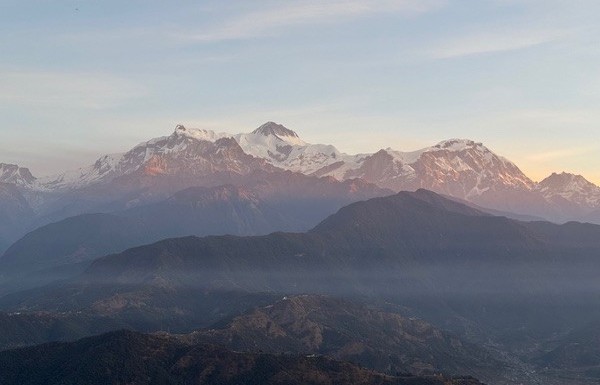
Our next meeting will be held in Seoul, hosted by the Korean Medical Association and I look forward to our next meeting with a meal of bibimbap washed down with soju. Meanwhile I leave everyone with a beautiful photograph of the Annapurna mountain range at sunrise!