This year marks the 60th year since the establishment of SMA News, and it is timely that we take a look back at the history of SMA and junior doctors in Singapore. In the beginning, there was the SMA Medical Officer (MO) Committee which advocated for various concerns, notably house officer call allowances (long ago, our house officers were not paid for going on call).1 Committee members at the time included current SMA Council members Adj Prof Tan Sze Wee and Dr Wong Chiang Yin, as well as past Council member Prof Wong Tien Yin.
The SMA MO Committee later became the SMA Doctors-in-Training (DIT) Committee, which has since continued to advocate for our young doctors. For example, in 2016, the DIT Committee received feedback that reservist leave was considered as being part of the leave quota in some institutions, but not in others. Dr Wong Tien Hua, then President of the 56th SMA Council, wrote on behalf of the Committee to the Ministry of Defence and Designated Institutional Officials to recommend that reservist leave should not be considered part of the leave quota for residents.2 Back then, the DIT Committee members included current SMA Council members Clin Asst Prof Benny Loo Kai Guo, Clin Asst Prof Lim Kheng Choon and Adj A/Prof Ng Chew Lip. Their early advocacy laid the foundation for the continuous investment in the development of our junior doctors.
Changes concerning junior doctors
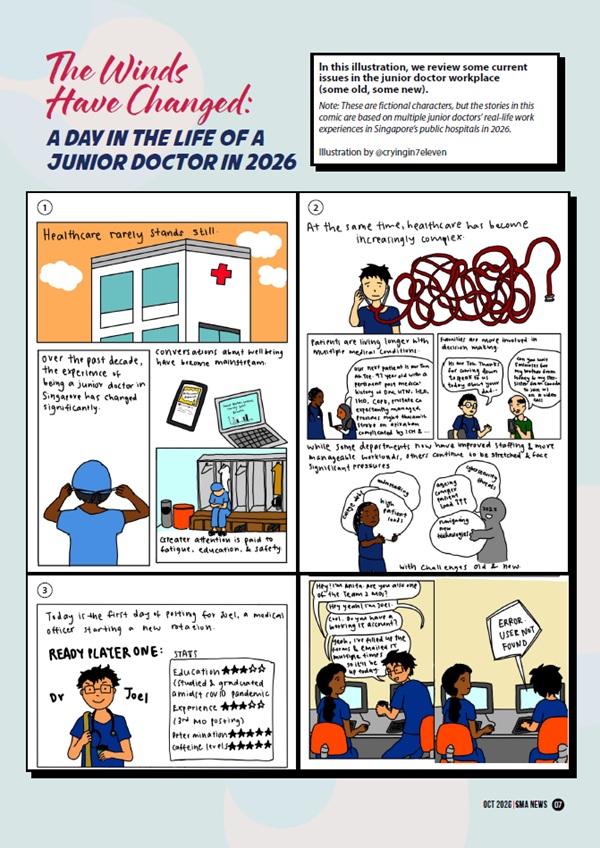
There has been a lot of talk about healthcare transformation and the need for change. Similarly, over the past few decades, much has changed with regard to the experiences of junior doctors (such as reduced working hours but higher administrative loads), and our current DIT Committee members Dr Caitlin O'Hara and Dr Haidah Kamal have published their findings in the Annals of the Academy of Medicine, Singapore.3
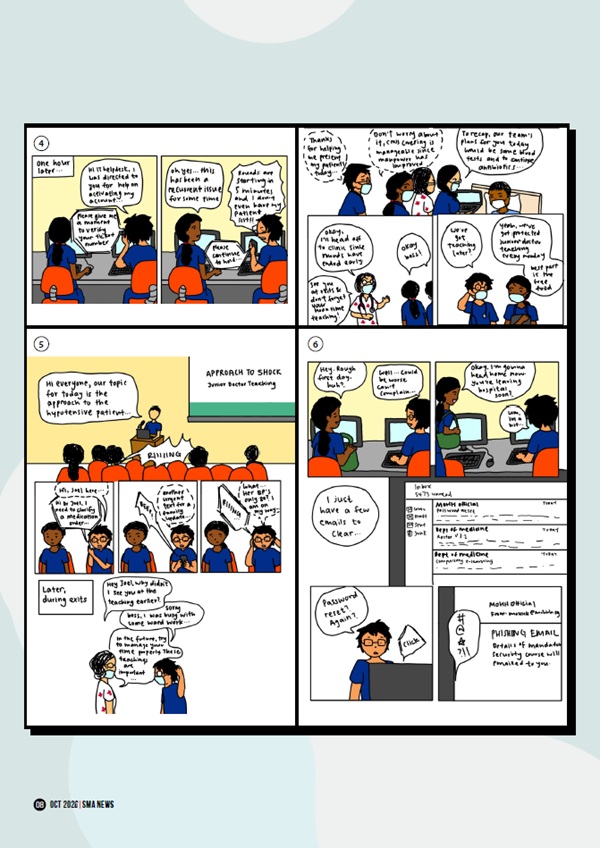
In medical education, our three medical schools are constantly improving their practices. Singapore's shift to the ACGME-I residency system comes with increased documentation of supervision from faculty, more formal assessments and feedback, and stipulated protected time for learning.4,5 Yet, despite this, the SMA DIT Committee recognises that many junior doctors need guidance in the workplace. We hence transformed our junior doctor guidebook into a phone application that is accessible on the go. We know that starting work is hard – our aim is to ease the steep learning curve for new house officers or medical officers, supported by initiatives such as our annual "starter pack" workshops.
In terms of numerical workload, the overall patient-to-doctor ratio has improved. We support the plan from MOH Holdings (MOHH) to increase manpower to enable the 24/80/1 work hour model (a maximum stretch of 24 consecutive hours, cap of 80 hours per week, and at least one rest day per week).6 However, each patient case is now more complicated. Current junior doctors cite new difficulties in the workplace: a concerning medico-legal landscape, defensive medicine, complex patient needs and expectations, and higher administrative loads. In 2021, the Ministry of Health (MOH) established the National Wellness Committee for Junior Doctors (NWC-JD).7 Our representatives in the NWC-JD advocated for issues such as improved assistance for doctors at risk of burnout in an increasingly complex healthcare landscape, improved access and competitiveness of career and training opportunities for junior doctors, and automated work-related claims/work-hour tracking through electronic medical record use, allowing doctors to spend more time focusing on patient care.8
Helping ourselves, helping others
SMA's slogan is "For Doctors, For Patients". Amid the evolving healthcare landscape and assistance of artificial intelligence, we must continue to strive for clinical excellence and invest in ourselves. Beyond medical expertise, there are numerous soft skills and hidden curriculums that are equally important to develop. Examples include communication skills and documentation, resource management and allocation as well as quality improvement. With improved patient-to-doctor ratios, there are concomitant reduced learning experiences for junior doctors. Educators and learners need to be aware of any deficiencies that arise in training and actively address them.
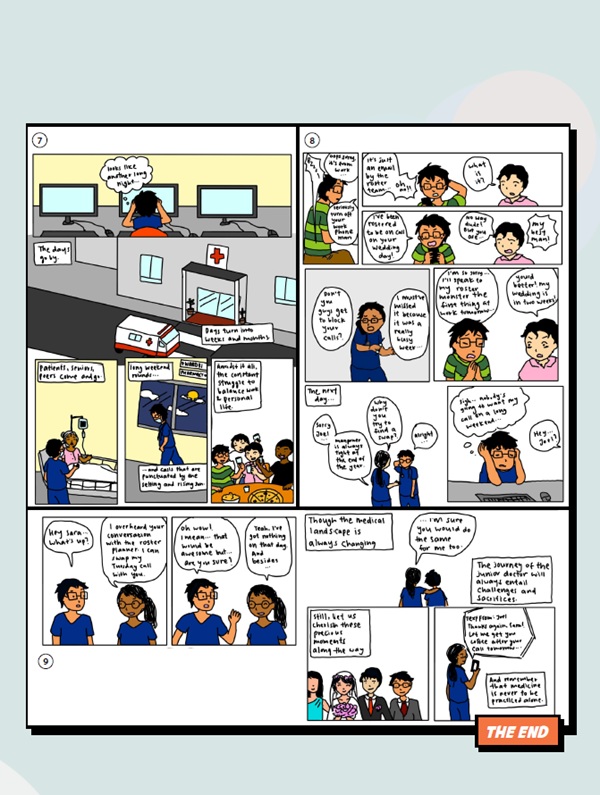
There have also been increased efforts nationwide to support the mental health of our population. Concerns raised by junior doctors in this domain include the fear of stigma in the workplace and being treated differently from other doctors if they were to declare their symptoms or diagnoses. Together with representative psychiatrists and occupational health physicians from the College of Psychiatrists, Academy of Medicine, Singapore (AMS) and the College of Public Health and Occupational Physicians, AMS, the SMA DIT Committee established a workgroup to find a way to support our junior doctors better. The workgroup is developing the Well-Being, Inclusion, Safety and Equity (WISE) Guideline, to support the registration and practice of doctors with psychiatric conditions.
Apart from the numerous workplace improvements, we must not overlook the importance of supportive interpersonal relationships. The SMA DIT Committee encourages everyone to first take care of our colleagues, so that we can take better care of our patients. Nowadays, there are numerous avenues for junior doctors to turn to for help, be it within their department, hospital, MOHH or even outside of the workplace. We implore everyone to not go through medicine alone and to ask for help when you need it. Both senior and junior doctors should recognise that they play a pivotal role as mentors, near-peer teachers and friends.
The SMA DIT Committee will continue to advocate for junior doctors and medical students. We believe that every junior doctor deserves the same care and support that he/she gives to his/her patients. One day, our junior doctors will become the senior doctors taking care of Singapore's population. Let us continue to work together to support our junior doctors in their journey to become competent, confident and compassionate healthcare professionals.
SMA Doctors-in-Training 101
Access the guidebook here: https://smadit101.glide.page/
Installation instructions for your phone's operating system
Android
- Open page settings > Click "Install app"
-
Click "Install"
iPhone
-
Open in Safari settings > Click "Add to Home"
To stay up to date with the SMA DIT Committee:
If you are keen to get involved with SMA DIT efforts, please write in to us at dit@sma.org.sg.
The Winds Have Changed: A Day in the Life of a Junior Doctor in 2026
In this illustration by @cryingin7eleven, we review some current issues in the junior doctor workplace (some old, some new).
Note: These are fictional characters, but the stories in this comic are based on multiple junior doctors’ real-life work experiences in Singapore’s public hospitals in 2026.