"Wow, so you're going to be Steve Jobs?" one of my senior medical oncologist colleagues joked when he saw me along the corridor during ward rounds. After I announced my decision to leave full-time practice, another colleague reminded me, half in jest, to let her know when my company would launch its initial public offering (IPO). I am neither on the Forbes list nor ringing the bell on the Nasdaq index, but the company remains standing more than seven years on and I am grateful to the SMA News Editors for being sufficiently interested to allow me to share my reflections on this journey.
My startup, Oncoshot, is a technology company that works with public and private cancer centres. Originally intended to assist patients with clinical trial matching, it has evolved to support clinical research teams with evidence generation, clinical trials matching and cross-border clinical research by automating data extraction from deidentified clinical notes. Compared to manual chart abstraction, data automation has improved data collection and pre-screening workflows by 60% to 80% across projects in Singapore. Cancer patients at one of our local sites are being screened across five to ten trials on a daily basis across a complex set of eligibility criteria to improve their chances of accessing trials during the narrow window of opportunity they generally have.
Two moments that changed everything
I have always been enamoured with the Internet. In Secondary 1, I was already obsessed with the dot-com bubble, and I admired the likes of Jeff Bezos for his vision and ability to solve a "knowledge gap" for consumers without being either the creator or owner of the asset. I found the world of platforms and marketplaces fascinating. Now, my first love was always medicine (possibly a byproduct of some subtle but highly effective Indian parental preconditioning), but over the next few decades, I always found myself getting drawn to the world of technology, and later to the intersection between technology and healthcare.
There were two distinct moments that changed my mental model on how technology could improve healthcare and clinical research. The first moment was during my time serving National Service as a medical officer. Among the roles that were available after our cadet course was that of a project officer supporting the daily operations of the Singapore Armed Force's second-generation electronic medical record (EMR) system.
Working with the EMR, not as a doctor- user but at the backend, taught me to recognise the challenges with how patient information was recorded yet largely unanalysable, and how patient journeys were disconnected as they moved across different sites of care, such as from a military medical centre to a specialist unit in a public hospital. This gave me a profound appreciation for how healthcare as a whole had built deeply entrenched, regulated systems that focused almost singularly on the interaction between a doctor and patient. Today, systems globally struggle to see the interaction between patients and their larger care ecosystem (eg, GPs, specialists, insurers and even fitness/health-monitoring applications). I also realised the inevitability of our systems of record transforming into systems of learning over the coming decades, and the opportunities for clinicians familiar with data and technology to be a part of this change.
The second moment of realisation came during my time as a registrar when I was working on establishing a unique database of some 130 breast cancer patients with industry support to perform DNA sequencing of specimens with the typically aggressive triple- negative subtype. What I struggled with most was manually piecing together the clinical and outcomes data and drawing insights from the genomic profiling. The inability to automate outcomes data collection made me question the sustainability and utility of research investments beyond the typical key performance index of a publication. It would be easy to say that going through such challenges would be part and parcel of performing research. My view was that research systems across the world needed to move away from wasting trained individuals on manually collating information, which inadvertently became stale and unusable when data needed to be refreshed. Manual systems would become untenable at some point, given that our world was already experiencing an explosion in the volume and speed of healthcare data generation. I was convinced at the time that the requisite technology was sufficiently mature to improve clinical research processes and translate these improvements into better patient outcomes with greater efficiency – only to learn that it would take several more years.
Preparation for the long grind
During my 20s and early 30s, I dabbled in investing a significant amount of my personal time, and a small amount of capital, in start-ups that some of my nonmedical friends and extended family had pursued. While none of these succeeded, I consider these failed experiments an important period that taught me the basics of risk-taking, pivoting quickly, recognising product-market fit, and, most crucially, building a set of personal principles to know when to call it quits.
I was grateful then (and even more so now) for my bosses at National Cancer Centre Singapore who recognised that I was probably an oddball treading on a space that was more technology than oncology, and who supported my intent of building technology to improve cancer research. In one of the discussions, I recall explaining how I had found Ruslan, my cofounder originally from Russia, and that I had already convinced him to leave his leadership role at a UK-listed e-commerce platform. It was a daunting idea to sacrifice my work with patients, but it was also clear to me that I had to dedicate my energy to the start-up or risk failure for both of us. Skin in the game? Check. I guess it was at that moment that my bosses realised that I was "all in" and were graciously willing to allow me to give it a go.
Our early collaborations were fraught with challenges where the technology was immature and unable to embed in complex ecosystems where stakeholders could not realistically prioritise a collaboration with a start-up. It took us several years to progressively build different parts of the solution with partners across several countries before we could benefit from the new advances in artificial intelligence and large language models. This new wave allowed us to solve some of the most challenging aspects of data extraction that we struggled with earlier. We persisted long enough to benefit from this technological maturity.
Soul in the game and thinking long term
Today, I am more focused on achieving scale. Building a platform that services hospitals requires significant capital, and comparable infrastructure remains limited outside developed markets. But the value we create is intrinsically tied to the breadth of institutions we serve and the trust we build with each one. Almost all healthcare innovations from Singapore need to find an overseas path to commercialise early. We are grateful that beyond our regional partners, we now have customers in the European Union and also partner with leading cancer centres in New York and Texas, USA for cancer registry automation and cross-border research.
The jokes about Steve Jobs and IPOs still surface from time to time. There has been no explosive growth spectacle or bell-ringing to talk about. What has endured is a conviction that innovation in healthcare and research rarely comes from grand moments – it comes from staying close to the systems, the clinicians, the research coordinators and the patients. Nassim Taleb writes about "soul in the game" and how it encapsulates a greater sense of risk. I think it captures what doctor-entrepreneurs uniquely bring to the table: the determination to persist because we have seen firsthand what is at stake when we do not.
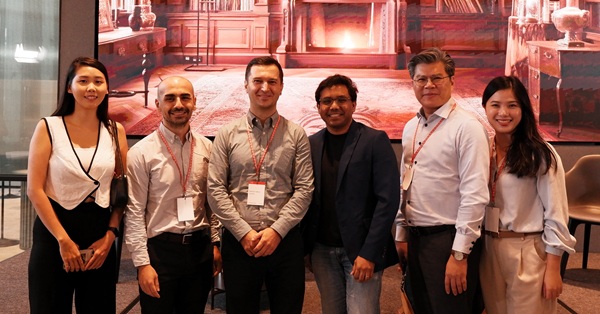
Some members of Oncoshot's Singapore team